巴菲特 1960 年致股东的信(英文版)
WARREN E. BUFFETT
5202 Underwood Ave.
Omaha, Nebraska
5202 Underwood Ave.
Omaha, Nebraska
The General Stock Market in 1960
A year ago, I commented on the somewhat faulty picture presented in 1959 by the Dow-Jones Industrial Average which had advanced from 583 to 679, or 16.4%. Although practically all investment companies showed gains for that year, less than 10% of them were able to match or better the record of the Industrial Average. The Dow-Jones Utility Average had a small decline and the Railroad Average recorded a substantial one.
In 1960, the picture was reversed. The Industrial Average declined from 679 to 616, or 9.3%. Adding back the dividends which would have been received through ownership of the Average still left it with an overall loss of 6.3%. On the other hand, the Utility Average showed a good gain and, while all the results are not now available, my guess is that about 90% of all investment companies outperformed the Industrial Average. The majority of investment companies appear to have ended the year with overall results in the range of plus or minus 5%. On the New York Stock Exchange, 653 common stocks registered losses for the year while 404 showed gains.
Results in 1960
My continual objective in managing partnership funds is to achieve a long-term performance record superior to that of the Industrial Average. I believe this Average, over a period of years, will more or less parallel the results of leading investment companies. Unless we do achieve this superior performance there is no reason for existence of the partnerships.
However, I have pointed out that any superior record which we might accomplish should not be expected to be evidenced by a relatively constant advantage in performance compared to the Average. Rather it is likely that if such an advantage is achieved, it will be through better-than-average performance in stable or declining markets and average, or perhaps even poorer-than-average performance in rising markets.
I would consider a year in which we declined 15% and the Average 30% to be much superior to a year when both we and the Average advanced 20%. Over a period of time there are going to be good and bad years; there is nothing to be gained by getting enthused or depressed about the sequence in which they occur.
The important thing is to be beating par; a four on a par three hole is not as good as a five on a par five hole and it is unrealistic to assume we are not going to have our share of both par three's and par five's.
The above dose of philosophy is being dispensed since we have a number of new partners this year and I want to make sure they understand my objectives, my measure of attainment of these objectives, and some of my known limitations.
With this background it is not unexpected that 1960 was a better-than-average year for us. As contrasted with an overall loss of 6.3% for the Industrial Average, we had a 22.8% gain for the seven partnerships operating throughout the year. Our results for the four complete years of partnership operation after expenses but before interest to limited partners or allocation to the general partner are:
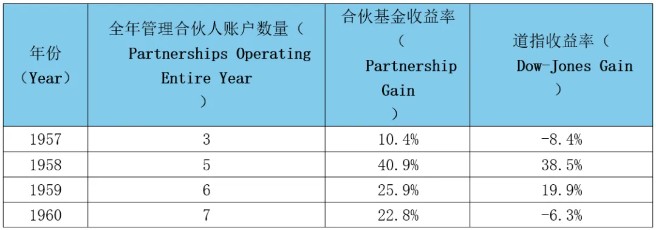
[Performance tables omitted for brevity]
It should be emphasized again that these are the net results to the partnership; the net results to the limited partners would depend on the partnership agreement that they had selected.
The overall gain or loss is computed on a market-to-market basis. After allowing for any money added or withdrawn, such a method gives results based upon what would have been realized upon liquidation of the partnership at the beginning of the year and what would have been realized upon liquidation at year end and is different, of course, from our tax results, which value securities at cost and realize gains or losses only when securities are actually sold.
On a compounded basis, the cumulative results have been:
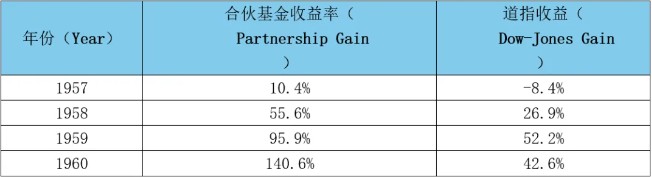
[Cumulative performance tables omitted for brevity]
Although four years is entirely too short a period from which to make deductions, what evidence there is points toward confirming the proposition that our results should be relatively better in moderately declining or static markets.
To the extent that this is true, it indicates that our portfolio may be more conservatively, although decidedly less conventionally, invested than if we owned "blue-chip" securities. During a strongly rising market for the latter, we might have real difficulty in matching their performance.
Multiplicity of Partnerships
A preceding table shows that the family is growing. There has been no partnership which has had a consistently superior or inferior record compared to our group average, but there has been some variance each year despite my efforts to keep all partnerships invested in the same securities and in about the same proportions.
This variation, of course, could be eliminated by combining the present partnerships into one large partnership. Such a move would also eliminate much detail and a moderate amount of expense.
Frankly, I am hopeful of doing something along this line in the next few years. The problem is that various partners have expressed preferences for varying partnership arrangements. Nothing will be done without unanimous consent of partners.
Advance Payments
Several partners have inquired about adding money during the year to their partnership. Although an exception has been made, it is too difficult to amend partnership agreements during mid-year where we have more than one family represented among the limited partners. Therefore, in mixed partnerships an additional interest can only be acquired at the end of the year.
We do accept advance payments during the year toward a partnership interest and pay interest at 6% on this payment from the time received until the end of the year. At that time, subject to amendment of the agreement by the partners, the payment plus interest is added to the partnership capital and thereafter participates in profits and losses.
Sanborn Map
Last year mention was made of an investment which accounted for a very high and unusual proportion (35%) of our net assets along with the comment that I had some hope this investment would be concluded in 1960. This hope materialized. The history of an investment of this magnitude may be of interest to you.
Sanborn Map Co. is engaged in the publication and continuous revision of extremely detailed maps of all cities of the United States. [...] (Full case study omitted for brevity, but follows the Chinese version's narrative on Sanborn's business model, valuation discrepancy, and control strategy.)
The auditors should be mailing your financial statement and tax information within about a week. If you have any questions at all regarding either their report or this letter, be sure to let me know.
Warren E. Buffett
1-30-61
1-30-61
上一篇:
巴菲特在1959年的投资策略有哪些特点?
下一篇:
巴菲特 1960 年致股东的信(中文版)